'THE ZULUS OF ZAMBIA'?
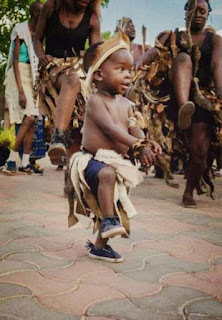
In February 2019, Mtengeluni village, 25 kilometers from the town center of Zambia's fifth city of Chipata, East of the country, came to life when Ngonis of Zambia, Malawi and Mozambique were in one accord as they celebrated the ncwala (fruits of the first harvest) in epic style.

The Guest of Honor with the Ncwala organizing Chair, Mkwinda Sakala.
Dazzling scenes characterized the ceremony, reminiscent of the Shaka Zulu Movie which chronicles the rise and fall of a great Southern African kingdom that reigned supreme in the region under their decorated leader, Shaka Zulu in the 1800s.
But it was not the Ngoni impis' illustrious Ngoma dance or the Bayette salutations or better still the spearing of a black bull that glorified this year's ncwala ceremony. It was the guest of honor, Prince Mongosuthu Buthelezi of the Zulu Kingdom of Kwazulu-Natal (KZN) South Africa who was the 'man of the moment' of the traditional spectacle.
Invited to grace the 2019 ceremony by the Ngoni Royal Establishment, Prince Buthelezi a former Minister in the South African cabinet, gave a moving, powerful and thought provoking speech that galvanized a kingdom and resonated well with the majority of Ngonis.
Referring to them as 'the Zulus of Zambia', the Zulu Kingdom Prince painted the Ngoni picture without a glitch, superbly reconnecting them to the traditional Nguniland of Kwa Zulu Natal. In his speech, the Ngonis relived their monumental journey from Zulu land; a dramatic journey that would last for 20 years. Buthelezi paid tribute to the Ncwala ceremony describing it as a 'symbolic act of hearing' and unifying factor among the Ngonis.

Shenge stole the limelight with a powerful speech at one of the regions biggest traditional piece.
The Prince also briefly touched on the highly debated decision by the Mpezeni IV to ban the bare breast spectacle. He stated that in Zulu land the practice was still alive and that in Zulu Kingdom, they had not yet reached that level of 'maturity' to ban the historical practice.
He also reminded the Ngonis and the government of Zambia that the title of paramount chief is a colonial title which should not find itself in societies that had broken free from their colonial masters. He pointed out that in Zulu land such a title had been scrapped off and replaced with 'Amakhosi' or simply King and that such an issue should be looked into by the Ngonis and the government of Zambia at large.
In his greatly praised reconstruction of Ngoni ancestry, Prince Buthelezi lectured the Ngonis that their inspirational figurehead, Zwangedaba had the last name of 'Jele' and not 'Jere' as most Ngonis of today are known. The royal figure also recounted his first discovery of the Ngonis in Zambia and Malawi in the 1980s confessing that he broke down to learn that he had brothers outside Zulu Kingdom borders.
Meanwhile paramount chief Mpezeni IV asked the Prince to help them resuscitate their seemingly oblivious original Ngoni language by sending Zulu teachers to Ngoniland so that their language is added back to their rich heritage.
The Ngonis trace their origins from Kwa Zulu Natal province of South Africa where they were referred to as Nguni people.They left Zulu land around 1820 led by their inspirational figurehead Zwangendaba to escape the Mfecane. They carried the ncwala with them and despite 'trials and tribulations' the ceremony still stands tall; it is held every last Saturday of February. The Zulus also celebrate the same ceremony in December every every year, they too slaughter a black bull like their Ngoni brothers.

iNgwenyama Mpezeni IV,the principal leader of the Zambian Ngonis rejuvenates himself by drinking the blood of the black bull at the eMthengeluni arena, during Ncwala 2019.
NEWSLETTER OF PRINCES BUTHELEZI AFTER HIS INVITATION AT THE NCWALA.
Dear friends and fellow South Africans,
As our flight departs Lusaka from Kenneth Kaunda International Airport, I have a moment to reflect on the past four days, which I have spent in the company of two IFP National Council members, the Mayor of Umzinyathi District and the Mayor of Nkandla.
I was invited by His Royal Highness Inkosi Yama Khosi Paramount Chief Mpezeni IV to participate in the Nc’wala Traditional Ceremony of the Ngoni people of Eastern Province in Zambia. This symbolic ceremony is central to the Ngoni’s cultural heritage and is attended from far and wide by thousands upon thousands of people under the ten traditional leaders who serve under HRH Mpezeni IV.
In previous years, President Peter Mutharika of Malawi and former President Joachim Chissano of Mozambique have addressed the Nc’wala Ceremony, for the Ngoni people have historical ties to these neighbours. But their deepest roots are in the Zulu Nation, for the Ngoni originated in Zululand. They began migrating with the rise of King Shaka kaSenzangakhona.
I was therefore honoured, as the traditional Prime Minister to the Zulu Monarch and Nation, to attend this ceremony and to speak on behalf of the Zulu Royal family. It was deeply moving to see the Ngoni people – men, women and children – dancing and singing in a joyous celebration.
It was very similar in feel to the Umkhosi woSwela of the Zulu Nation, and for good reason. The Nc’wala Ceremony is based in a shared cultural heritage of Ukunyatela, the First Fruits Ceremony, which was celebrated in Zululand at the time of King Shaka.
Being in Zambia again was a blessing on many counts, for it gave me the opportunity not only to meet with His Excellency President Edgar Chagwa Lungu, but to visit my friend of many years, His Excellency Dr Kenneth Kaunda, the first President of a liberated Zambia.
Seeing Dr Kaunda again after all these years was truly remarkable. When I celebrated my birthday in August last year, he sent his son, Colonel Panji Kaunda, with a warm message of support. I still hoped however to see Dr Kaunda in person. This wish has been fulfilled; and it was wonderful.
Dr Kaunda and I reminisced on our meeting in 1974 when I visited State House in Lusaka to thank him for giving sanctuary to all our exiles in the liberation struggle. Zambia had been free for a decade already, but President Kaunda, like many African leaders, did not consider the struggle won while South Africa was still in chains. He lent us support, for which we shall always be grateful.
I have a further reason to be grateful for President Kaunda’s visionary leadership. During my visit in 1974, he advised me to form a membership-based organisation to reignite political mobilisation on our soil, in the hiatus created by the banning of the ANC and other political organisations.
Upon my return from Zambia, I discussed this with Mr Oliver Tambo, the ANC’s leader in exile, and with Bishop Alphaeus Zulu. They agreed that this was the best way forward for our struggle. Thus I founded Inkatha yeNkululeko yeSizwe, the national cultural liberation movement, in March 1975.
The birth of Inkatha, which became the IFP once liberation parties were unbanned, will forever be tied to that conversation with President Kaunda.
I will post a copy of his remarks at our meeting on Thursday online, for his words are historic. I was honoured when he asked me to visit the grave of uMama Betty Kaunda after our meeting. As I stood in silence at her graveside, my heart swelled with memories.
Earlier that afternoon, I had found myself welcomed again at State by President Lungu, who received me with warmth. The President and I share the privilege of having served our respective countries as Minister of Home Affairs. We also both studied law before entering politics. So we found interesting points of conversation.
Our hosts, the Nc’wala National Organising Committee, kindly arranged for us to be received on arrival in Lusaka by His Worship Mayor Miles Sampa. On arrival in Chipata, we were received by His Worship Mayor Sinoya Mwale. My colleagues, Mayor Arthur Thamsanqa Ntuli and Mayor Petros Ngubane, enjoyed comparing notes on the challenges of local governance and the enormous satisfaction there is in serving one’s people with excellence.
I was interested to meet the Chairperson of the Organising Committee, Ms Mkwinda Sakala. She is the first female chairperson to be appointed by HRH Mpezeni IV which highlighted the theme of this year’s ceremony, “Preserving Our Cultural Heritage Through Gender Equality”.
This was a pertinent theme, for gender equality must be placed high on the agenda in every forum, whether it is political or cultural. As I told President Lungu, I appreciated his appointment of Mrs Inonge Wina as Vice President of Zambia, for when I led the administration of the KwaZulu Government I appointed women to my Cabinet knowing that women are the backbone of our society and leaders in our nation.
I will post my remarks at the Nc’wala Ceremony online as well so that anyone interested can read for themselves the fascinating history between the Ngoni people and the Zulu Nation, and the hardship we both experienced under the colonial authorities. Among the many indignities we suffered, we endured the banning of our cultural ceremonies.
I thought however that I should commit to paper my experiences in Zambia over the past four days, as this was a very special time.
Yours in the service of our nation,
PRINCE MANGOSUTHU BUTHELEZI MP
PRESIDENT OF THE INKATHA FREEDOM PARTY.

The author is a Ngoni from Langa Village, in senior chief Nzamane's Chiefdom, less than 35 kilometers from Mtengeluni. He holds a Bachelors Degree in Library and Information Science and Development Studies.


This is a very rich story and educative sir,thank you so much and looking forward to read another for 2022
ReplyDeleteWe are here sir
Delete